01. The Plate-making Process
Plate-making is a crucial step because it directly impacts the quality of the product. Nowadays, most factories use digital machines for plate-making, which has improved the process a lot. It involves exposing the plate, developing it, refining it, and then printing the design.
Gift boxes are all about looking new and attractive. That’s why they come in many different colors. For example, a single style of gift box can have four basic colors plus a few special ones like gold and silver.
02. How to Choose the Right Paper?
Before cutting the paper, we also need to choose the right paper.
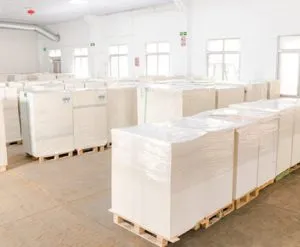
Generally, the inside of gift boxes in packaging boxes is made of grey board paper, while the outside is laminated with colored paper or specialty paper. Colored paper is typically made of double copperplate and matte copperplate paper. Some use 80g, 105g, 128g, 157g, etc. These weights of paper are commonly used, and it’s rare to use paper heavier than 200g for laminating the outside of gift boxes. This is because thicker colored paper can easily bubble when laminated onto the gift box, and it looks rigid.
Of course, the choice of paper and process depends on the product. Designing the outer packaging according to the product and then selecting the paper and process accordingly.
The video will show you how we cut paper.
03. The Process of Printing Codes on Packaging Boxes.
Coding: The process of using a coding machine to print information codes on products, including traceability codes, production dates, shelf life, batch numbers, etc. This is done by using a coding machine to spray-print identifiers on the products.
04. The Principle of Packaging Box Printing
The printing principle of packaging boxes involves transferring text and image information from a CTP plate to a rubber blanket on the printing press through the process of ink and water repulsion. This transfer is achieved with a certain pressure, allowing the ink on the rubber blanket to be transferred onto the paper, thus reproducing the desired design or text.
05. The Process of Packaging Box Printing
06. Quality Inspection
The inspection machine uses image visual detection technology to conduct real-time comprehensive quality inspection of rapidly moving printed products and removes non-conforming products.
07. The Laminating Process
The laminating process for packaging boxes involves applying a transparent plastic film onto the surface of printed materials through heat pressing, serving the purpose of protection and enhancing gloss. Laminating is a major post-printing process that requires a clean, smooth, non-blurry surface without wrinkles or bubbles.
After laminating, paper boxes are protected from wear and tear, enhancing the brightness of printed patterns and making them less prone to damage, thus extending the box’s lifespan. Additionally, the plastic film provides protection against moisture, water, stains, abrasion, folding, chemical corrosion, and other factors.
Different laminating techniques yield different effects. For example, using matte film can make the colors of paper bags appear darker, giving a more stable and elegant look, while glossy film can make the box look brighter and more vibrant.
Laminating technology has been widely used in the printing industry. Commonly laminated packaging products include paper boxes, paper bags, adhesive labels, etc.
08. The Embossing Process For Packaging Boxes
The embossing process for packaging boxes involves using a set of corresponding concave and convex templates with graphic and text elements. The printing material is placed between these templates, and pressure is applied to create a raised embossed effect.
09. The Hot Stamping Process
For packaging boxes involves transferring the aluminum layer from hot-stamping foil onto the surface of the substrate to create a special metallic effect.
Because the primary material used in hot stamping is electroplated aluminum foil, it is also called electroplated aluminum hot stamping.
10. Die-Cutting Principle of Packaging Boxes
Die-cutting is the process of pressing specific-purpose paper or cardboard according to certain specifications, in order to create imprints on the paper or cardboard for easy folding.
11. Box Gluing Principle
Box gluing is the final step in the production of folded paper boxes, where individual pieces of paper boxes are glued together to form folded paper boxes.